National sports victories lift collective happiness in South Africa
A multi-year study of digital sentiment shows joint sporting triumphs lift public mood across South Africa, while similar victories in Australia and New Zealand leave national measures unmoved.
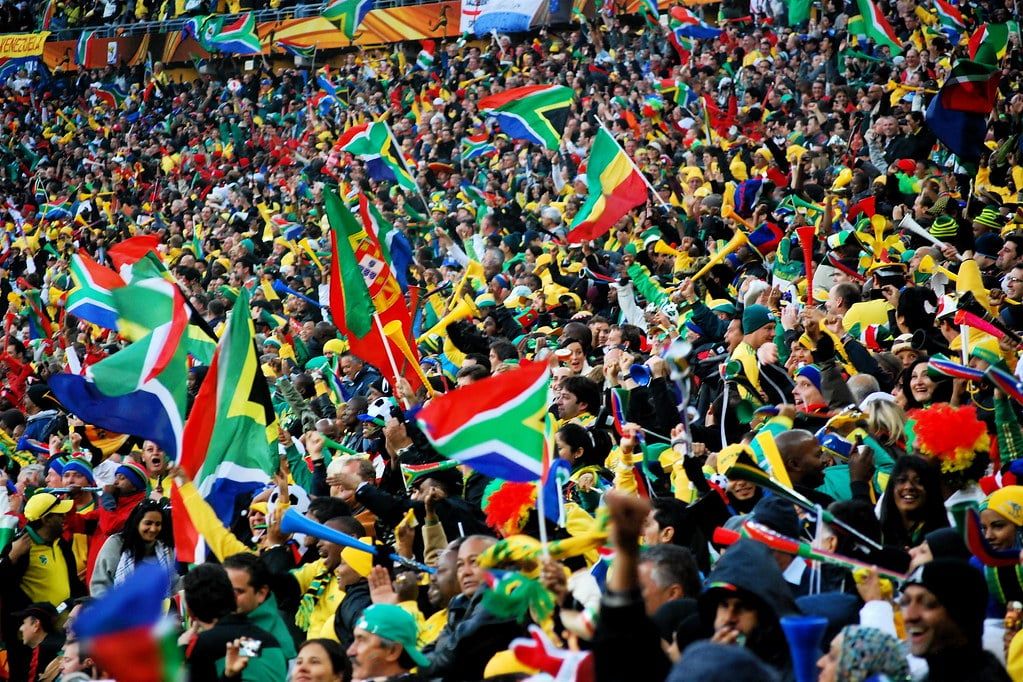
A stadium erupting in celebration offers one of the clearest displays of shared human joy. When a national team secures a victory, streets fill with car horns, flags and cheering crowds, suggesting that athletic success can temporarily elevate a country's spirits. Yet when social scientists attempt to track that feeling at the population level, the presumed emotional wave often vanishes into the background noise of ordinary life. In many sports-obsessed countries, victories in major international competitions leave barely a measurable ripple on aggregate measures of daily public mood.
Understanding how collective rituals influence emotional well-being matters because subjective well-being, the scientific measure of how people experience and evaluate their daily lives, reflects how resilient a society remains through economic shocks and social crises. If sports victories provide a measurable lift, they can serve as a potent social glue, fostering unity and temporary relief during difficult periods. Conversely, if the emotional high dissipates within hours or touches only committed supporters, athletic achievements remain private entertainment rather than a genuine driver of national well-being.
For a sporting outcome to shift an entire nation's mood, a specific chain of events must occur. A substantial fraction of the population must pay attention to the same contest, sharing a common emotional stake in the team. The outcome must then provoke an emotional reaction strong enough to carry over into routine social interactions and public conversation long after the final whistle. Finally, that emotional surge must be powerful enough to register above the routine personal burdens of work, inflation and health concerns that normally govern daily life. If any link in that chain breaks, the emotional charge stays confined to the grandstands.
How do sports outcomes shift daily emotional distributions?
Statistical models that focus only on population averages frequently miss changes that occur among specific groups of citizens. In a working paper posted to the University of Pretoria Department of Economics working paper series, economists Talita Greyling, Rangan Gupta, Onur Polat and Stephanie Rossouw analyzed how wins and losses in men's and women's cricket, football and rugby affected daily happiness scores between January 2020 and June 2023.123 To capture these shifts, the authors applied quantile regression, a statistical technique that estimates how an external shock influences different segments across an entire distribution rather than reporting only the central average.1
The authors reported that combined victories across rugby, cricket and football produced a statistically significant increase in happiness in South Africa.1 This emotional boost appeared most pronounced across the moderately low to high quantiles of the happiness distribution, meaning the positive lift occurred on days when the baseline national mood was already relatively stable or upbeat.1 In contrast, when the researchers examined Australia and New Zealand over the identical daily period from January 2020 to June 2023, where all three sports enjoy comparable popularity, they found little evidence that wins or losses altered daily happiness at any point along the distribution.1

Explaining the technical logic of this distribution, Rangan said in response to questions from Primary that the chosen quantile thresholds were directly tied to econometric modelling across the conditional distribution: "The statistically significant and insignificant effects on the conditional quantiles over the range of 0.10 to 0.90 are based on the estimation of the quantile regression." Rangan noted that values sitting below the median point capture days characterized by subdued public sentiment, whereas upper quantiles represent days when national mood runs higher than usual. Turning to where the effect peaks, Rangan told Primary that "The effect is the strongest (in terms of magnitude and significance) at the conditional quantile of 0.30, i.e., on days that corresponds to moderately low conditional quantiles of the GNH." Athletic success therefore provides its most reliable emotional dividend when baseline national sentiment is somewhat low, without extending to days of profound collective depression.
What mechanisms separate South Africa from its peers?
Cultural context shapes how sporting triumphs reverberate through society. Rangan said that historical memory plays a decisive role in why South African sentiment responds to athletic outcomes in ways other nations do not mirror. As Rangan told Primary, "One possibility is that sport has a particularly important unifying role in South Africa. There is obviously a historical precedent for that. The 1995 Rugby World Cup and Nelson Mandela’s very deliberate use of the Springboks as a symbol of national unity is probably the best-known example." Rangan added that when a national squad prevails, "it can become something that is collectively celebrated across the country."
That unifying mechanism does not operate uniformly in peer nations that follow identical sporting traditions. Rangan pointed out that "Having similar sporting cultures does not necessarily mean that the impact will be same in New Zealand and Australia compared to South Africa." For Australian and New Zealand citizens, Rangan noted that calendar routines and economic news exert far greater influence on mood: "Based on the model and our results, holidays, Fridays, and uncertainties in the financial market matters more for these countries. There is, however, some evidence that at the highest conditional quantile of the GNH for Australia, losses do reduce happiness."
To isolate the specific contribution of match outcomes, the researchers controlled for daily fluctuations in macroeconomic and financial variables, aiming to prevent omitted-variable bias, where unaccounted economic shifts might masquerade as sporting effects.1 In their comparative analysis across South Africa, Australia and New Zealand, the authors observed shared emotional baselines: Fridays and statutory holidays generated significant increases in happiness across entire conditional distributions in all three nations, while rising coronavirus infections and financial market uncertainty depressed happiness within specific distributional segments.1
When asked how the magnitude of sporting victories stacks up against these common baseline drivers, Rangan cautioned that direct comparisons require further statistical transformation: "Our objective was to see if wins in sports tend to increase the GNH by controlling for other predictors, and we do find that it ranges between 0.38 and 0.18 standard deviations of the GNH." Rangan explained that the model did not standardize every variable to have identical unit variance, meaning researchers cannot state whether a rugby victory carries greater weight than a public holiday.

These South African findings align with a wider international research tradition that examines how elite athletic participation affects life satisfaction. In an earlier investigation published in Cattaneo University's European Journal of Comparative Economics, researchers Dieudonné Mignamissi, Eric Xaverie Possi Tebeng, Aristophane Djeufack Dongmo, and Laquintine Mama Nji Mboumbouo examined 118 nations and demonstrated that accumulating points through participation in the FIFA World Cup is positively correlated with national happiness.5 Where that broader global study tracked long-term national rankings across dozens of countries, the University of Pretoria study demonstrates that day-to-day sporting success can provide an immediate emotional dividend under specific national conditions.
What can these happiness metrics leave unexplained?
The findings reflect a statistical association derived from observational digital data rather than a controlled psychological experiment. Daily happiness was measured through sentiment algorithms applied to publicly accessible social media posts on Twitter, now X, which means the underlying sample reflects the active online population rather than a perfectly balanced demographic cross section of South Africa.1 Conceding this constraint, Rangan said: "We do note in the paper that, as the corpus consists of tweets, it may not fully represent the broader national population."
Accounting for concurrent public events creates an additional methodological hurdle. Match days frequently coincide with unmeasured social developments, political speeches, or community milestones. Rangan acknowledged that the analysis did not capture isolated events directly: "We did not explicitly control for individual political or social events that occurred on match days. It would be almost impossible to identify and control for every event that could potentially affect happiness on a particular day." Instead, the regression architecture accounted for broad structural forces including monetary policy, exchange rates, fuel costs and pandemic infection counts. Because non-sporting events do not occur systematically on victory days, Rangan argued that unscheduled occurrences inject random noise into the calculations rather than biasing the core pattern.
The paper does not show whether the measured happiness boost translates into tangible behavioural changes, such as increased workplace productivity or shifts in personal spending. Furthermore, because the dataset spans the global coronavirus pandemic from January 2020 to June 2023, the emotional sensitivity of the public may have been heightened by lockdowns and restricted social gatherings.
As governments and statistical agencies incorporate measures of subjective well-being into broader social policy frameworks, understanding why certain societies draw profound emotional sustenance from sports while others remain indifferent becomes increasingly relevant. For South Africa, where rugby, cricket and football historically carried deep political and social symbolism, shared victories appear to bridge ordinary anxieties in ways that wealthier peers like Australia and New Zealand do not mirror. Future research will need to establish whether this emotional resonance endures during calmer macroeconomic periods, or whether sporting triumphs act primarily as a temporary refuge during times of acute collective distress.
This piece was prepared from the University of Pretoria working paper and public records together with answers from Rangan to seven questions from the Primary news team, completed September 2026.2
The record
23 sentences trace to 4 sources and 1 contributor.
- 1 Sports and Happiness in South Africa: Evidence from a Quantile Regression Approach Not published online
-
2
UO
University of Pretoria, Department of Economics Third-party reporting · ideas.repec.org Working Papers, University of Pretoria, Department of Economics | IDEAS/RePEc See the source
-
3
UO
- 4 Contribution — Rangan Gupta 16 statements added to this article
-
5
CU
ideas.repec.org7 pages
- Factors Driving the Growth in Fertilizer Consumption in Keny
- OSF Preprints, Center for Open Science | IDEAS/RePEc
- EconStor Preprints, ZBW - Leibniz Information Centre for Economics | IDEAS/RePEc
- Publications of University of Connecticut Economics PhD Alumni | IDEAS/RePEc
- Authors | IDEAS/RePEc
- Rangan Gupta | IDEAS/RePEc
- Authors | IDEAS/RePEc
citec.repec.org1 page
Article history
-
Published 27 Oct 2026, 17:44Assembled by the Primary desk from 4 sources · 1 contributor · 23 cited sentences
-
Rangan Gupta, onur Polat and Stephanie Rossouw analyzed how wins and losses in men's and women's cricket
- Go to the sentence: To capture these shifts, the authors applied quantile regression, a statistical technique that estimates how an external shock influences different segments across an entire distribution rather than reporting only the central average.
- Go to the sentence: The authors reported that combined victories across rugby, cricket and football produced a statistically significant increase in happiness in South Africa.
- Go to the sentence: This emotional boost appeared most pronounced across the moderately low to high quantiles of the happiness distribution, meaning the positive lift occurred on days when the baseline national mood was already relatively stable or upbeat.
- Go to the sentence: In contrast, when the researchers examined Australia and New Zealand over the identical daily period from January 2020 to June 2023, where all three sports enjoy comparable popularity, they found little evidence that wins or losses altered daily happiness at any point along the distribution.
- Go to the sentence: Explaining the technical logic of this distribution, Rangan said in response to questions from Primary that the chosen quantile thresholds were directly tied to econometric modelling across the conditional distribution: "The statistically significant and insignificant effects on the conditional quantiles over the range of 0.10 to 0.90 are based on the estimation of the quantile regression."
- Go to the sentence: Turning to where the effect peaks, Rangan told Primary that "The effect is the strongest (in terms of magnitude and significance) at the conditional quantile of 0.30, i.e., on days that corresponds to moderately low conditional quantiles of the GNH."
- Go to the sentence: As Rangan told Primary, "One possibility is that sport has a particularly important unifying role in South Africa. There is obviously a historical precedent for that. The 1995 Rugby World Cup and Nelson Mandela’s very deliberate use of the Springboks as a symbol of national unity is probably the best-known example."
- Go to the sentence: Rangan added that when a national squad prevails, "it can become something that is collectively celebrated across the country."
- Go to the sentence: Rangan pointed out that "Having similar sporting cultures does not necessarily mean that the impact will be same in New Zealand and Australia compared to South Africa."
- Go to the sentence: For Australian and New Zealand citizens, Rangan noted that calendar routines and economic news exert far greater influence on mood: "Based on the model and our results, holidays, Fridays, and uncertainties in the financial market matters more for these countries. There is, however, some evidence that at the highest conditional quantile of the GNH for Australia, losses do reduce happiness."
- Go to the sentence: To isolate the specific contribution of match outcomes, the researchers controlled for daily fluctuations in macroeconomic and financial variables, aiming to prevent omitted-variable bias, where unaccounted economic shifts might masquerade as sporting effects.
- Go to the sentence: In their comparative analysis across South Africa, Australia and New Zealand, the authors observed shared emotional baselines: Fridays and statutory holidays generated significant increases in happiness across entire conditional distributions in all three nations, while rising coronavirus infections and financial market uncertainty depressed happiness within specific distributional segments.
- Go to the sentence: When asked how the magnitude of sporting victories stacks up against these common baseline drivers, Rangan cautioned that direct comparisons require further statistical transformation: "Our objective was to see if wins in sports tend to increase the GNH by controlling for other predictors, and we do find that it ranges between 0.38 and 0.18 standard deviations of the GNH."
- Go to the sentence: Daily happiness was measured through sentiment algorithms applied to publicly accessible social media posts on Twitter, now X, which means the underlying sample reflects the active online population rather than a perfectly balanced demographic cross section of South Africa.
- Go to the sentence: Conceding this constraint, Rangan said: "We do note in the paper that, as the corpus consists of tweets, it may not fully represent the broader national population."
- Go to the sentence: Rangan acknowledged that the analysis did not capture isolated events directly: "We did not explicitly control for individual political or social events that occurred on match days. It would be almost impossible to identify and control for every event that could potentially affect happiness on a particular day."